Sensia RoboticsSensia DataKit
Turn real-world actions into training data.
Combine handheld, wrist-mounted, first-person and full-body capture with mobile edge computing, built around the task.
Sensia DataKit UMI-Gripper
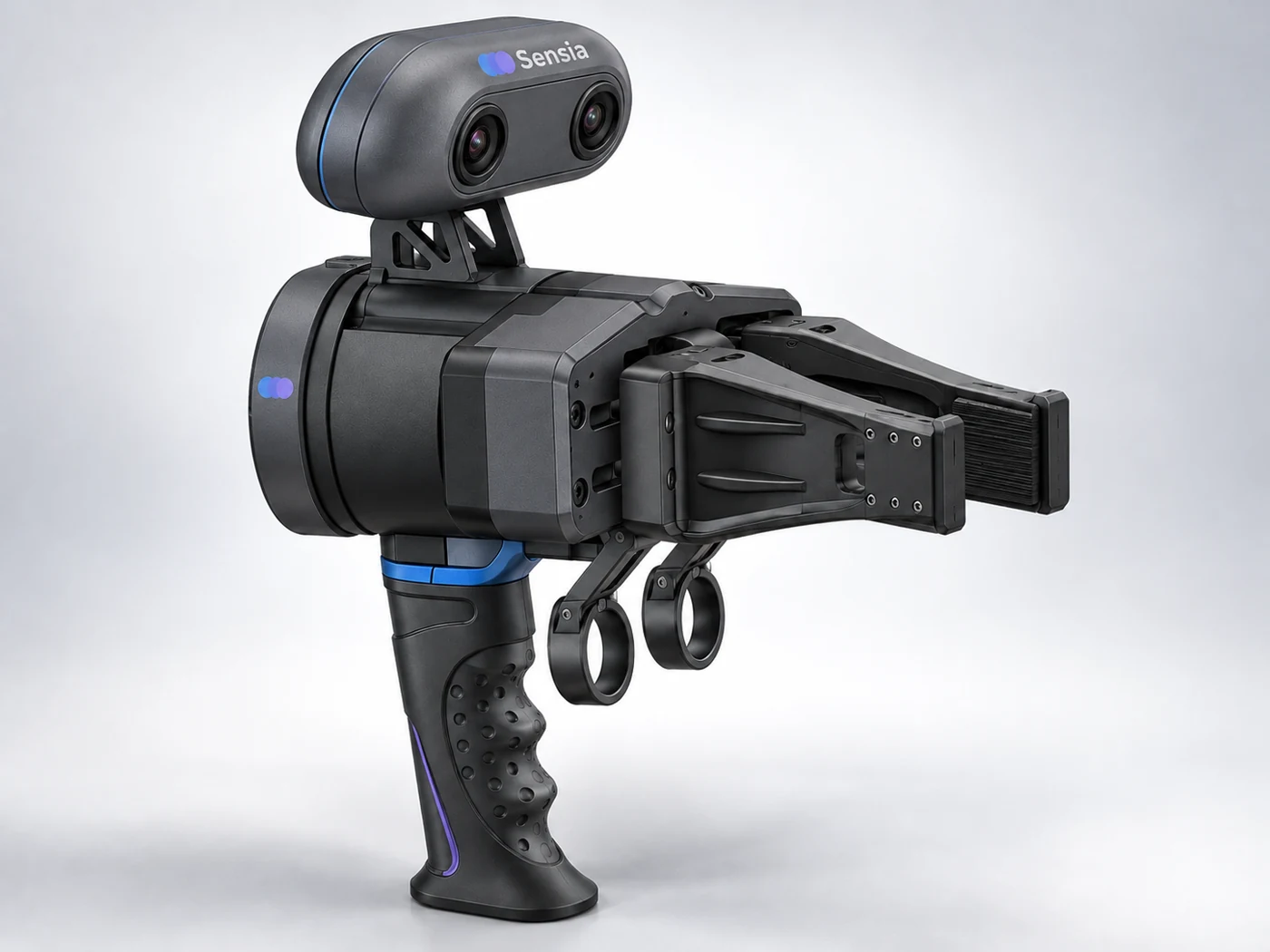
Capture stereo vision, inertial data and gripper state in one device, then use the same gripper as a robot end effector for active manipulation.
Capture and execute
Record stereo RGB, IMU, VIO trajectories and gripper state during handheld demonstrations. Mount it on a robot to receive gripper commands.
Parallel gripping with feedback
Rigid parallel fingers support passive guidance and active servo operation, with travel feedback and position, velocity or MIT torque control.
Optional fingertip touch
Add two fingertip sensors to record 3D distributed force, resultant force and resultant torque.
Export multimodal demonstrations
Organize captured data with the companion software and export LeRobot v3 datasets for imitation learning and manipulation policy training.
Specifications
Visual-inertial module
- Image output
- Stereo RGB, 1280 × 1024 at 30 Hz
- Shutter and field of view
- Global shutter; 200° diagonal field of view
- Optics
- 1.6 mm focal length; 60 mm stereo baseline
- Inertial sensing
- 3-axis acceleration + 3-axis angular velocity at 200 Hz
- Within-module synchronization
- FPGA hardware sync; stereo < 10 μs, camera-to-IMU < 100 μs
- Data and depth
- RAW; depth reconstructed from stereo RGB
- Pose estimation
- VIO based on an in-house improved ORB-SLAM3 algorithm
- Interface and module power
- Type-C / USB 3.0; 5 V; visual-inertial module power < 2 W
Gripper and servo
- Use and operating modes
- Handheld capture / robot end effector; passive guidance / active servo
- Travel and position feedback
- 150 mm maximum; 1 kHz travel sampling; 16-bit Hall position sensor
- Control and motor torque
- Position, velocity and MIT torque control; rated 0.8 Nm, peak 3 Nm
- Gripper power and communication
- 24 V; XT30 (2+2); CAN at 1 Mbps
- Data export
- LeRobot v3 via companion capture software
Optional fingertip tactile sensors
- Quantity and size
- 2 sensors per gripper; 30 × 25 × 8 mm per sensor
- Outputs and channels
- 3D distributed force, resultant force and torque; up to 717 channels per sensor
- Range and minimum force
- Normal 0-25 N; tangential ±10 N; minimum detectable force 0.01 N
- Rate, repeatability and power
- Up to 1000 Hz; < 0.5% FS; 3-5 V
- Synchronization figures apply within a single visual-inertial module, not across devices. Companion software records timestamps and aligns data from combined devices.
- Depth is reconstructed from stereo RGB. VIO tracks device motion, not individual finger movements.
- LeRobot v3 export is provided by the companion capture software.
- The 5 V supply and < 2 W figure apply only to the visual-inertial module. The gripper uses 24 V. Torque figures describe motor output. Tactile sensors are optional.
Sensia DataKit UMI-Wrist
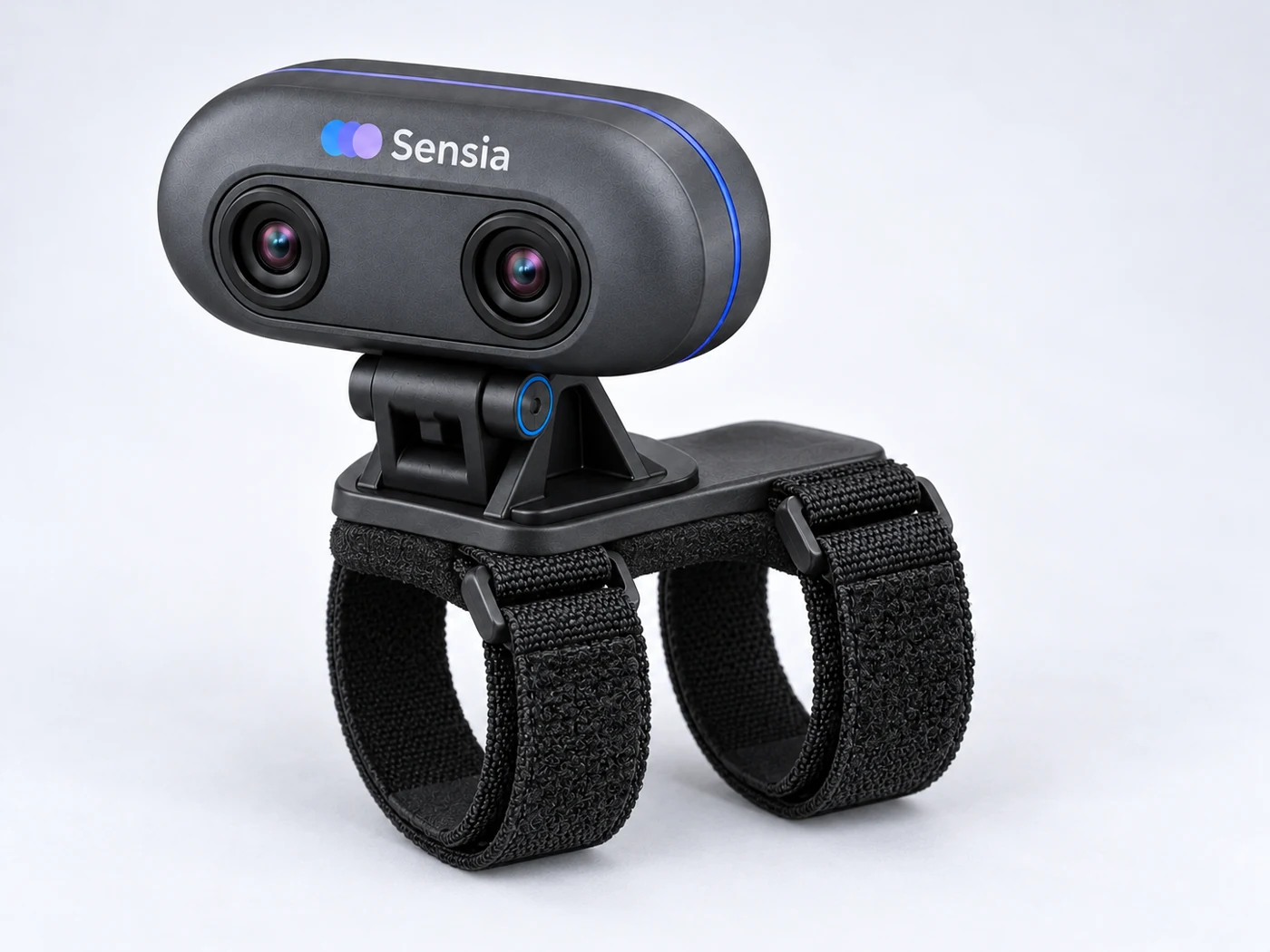
Keep both hands free while wrist-mounted stereo cameras and inertial sensors record close-up task views and device motion.
Close-up wrist views
A strap and support base hold the cameras near the task area, recording stereo RGB and enabling stereo depth reconstruction.
Device motion and pose
Record acceleration and angular velocity on three axes, and estimate the device trajectory with visual-inertial odometry.
Combine wrists and first-person views
Wear one on each wrist and pair them with EGO. Companion software timestamps and aligns the close-up and first-person data.
Standardized data export
Organize images, inertial data and device poses with the companion capture software, then export in LeRobot v3 format.
Specifications
Wear and data
- Mounting
- Wrist strap with support base
- Configurations
- Single wrist / both wrists; can be combined with EGO
- Outputs
- Stereo RGB, IMU data and device trajectories
- Data export
- LeRobot v3 via companion capture software
Visual-inertial module
- Image output
- Stereo RGB, 1280 × 1024 at 30 Hz
- Shutter and field of view
- Global shutter; 200° diagonal field of view
- Optics
- 1.6 mm focal length; 60 mm stereo baseline
- Inertial sensing
- 3-axis acceleration + 3-axis angular velocity at 200 Hz
- Within-module synchronization
- FPGA hardware sync; stereo < 10 μs, camera-to-IMU < 100 μs
- Data and depth
- RAW; depth reconstructed from stereo RGB
- Pose estimation
- VIO based on an in-house improved ORB-SLAM3 algorithm
- Interface and module power
- Type-C / USB 3.0; 5 V; visual-inertial module power < 2 W
- Synchronization figures apply within a single visual-inertial module, not across devices. Companion software records timestamps and aligns data from combined devices.
- Depth is reconstructed from stereo RGB. VIO tracks device motion, not individual finger movements.
- LeRobot v3 export is provided by the companion capture software.
Sensia DataKit EGO
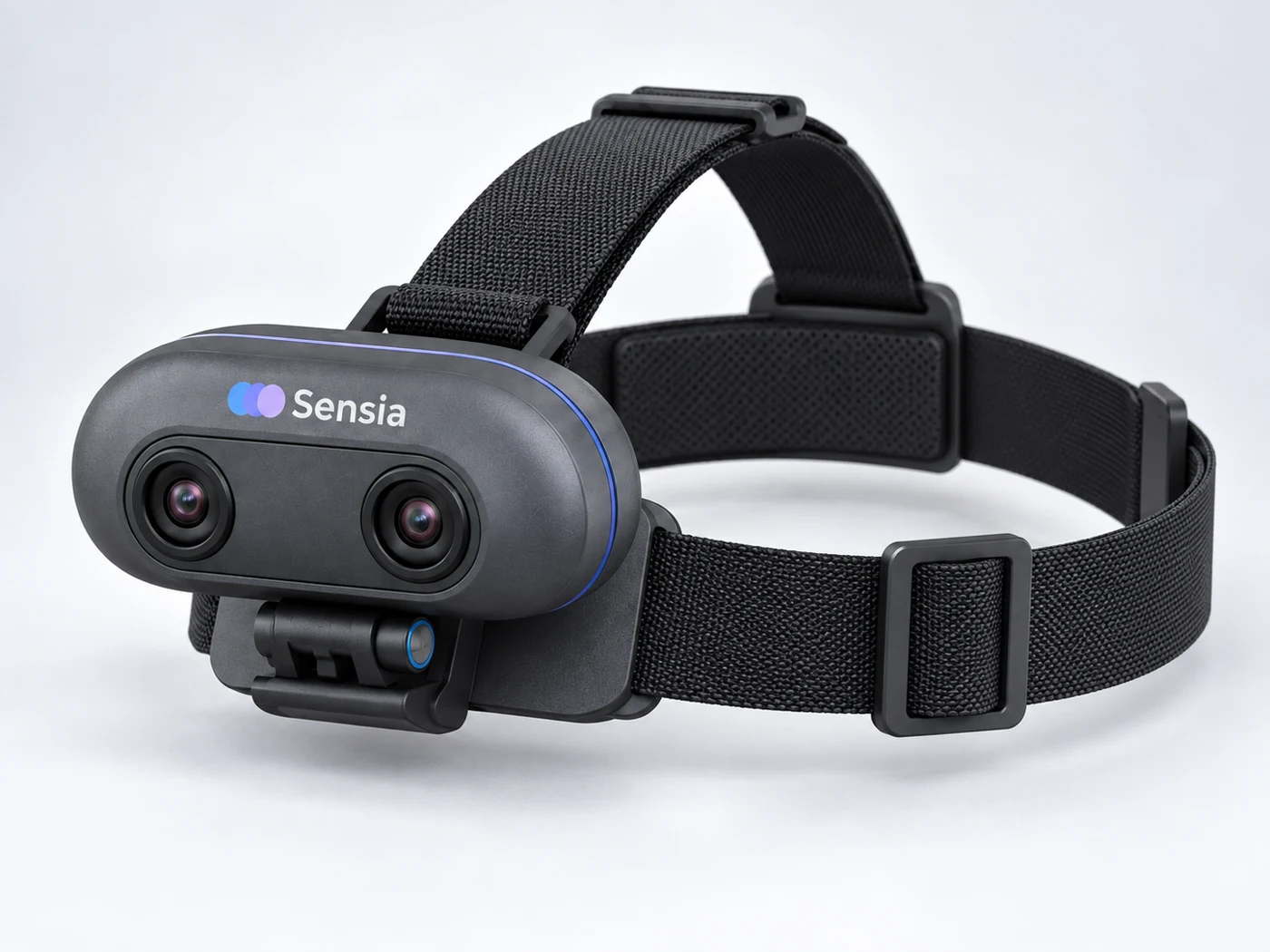
Record tasks from the operator's perspective, adding scene context and visual-inertial motion data to close-up hand demonstrations.
Keep the first-person context
Forehead-mounted stereo cameras follow the operator's viewpoint to record the scene, objects and task sequence.
Visual-inertial pose capture
Synchronize stereo images and IMU data within the module, track device motion with VIO and reconstruct depth from stereo RGB.
Connect multiple task views
Pair EGO with two UMI-Grippers or two UMI-Wrist devices. Companion software links first-person views, close-up views and device motion.
Export for policy training
Use the companion capture software to organize images, inertial data and poses, and export LeRobot v3 datasets.
Specifications
Wear and data
- Mounting
- Forehead-mounted with a head strap
- Capture viewpoint
- First-person stereo view
- Outputs
- Stereo RGB, IMU data and device trajectories
- Data export
- LeRobot v3 via companion capture software
Visual-inertial module
- Image output
- Stereo RGB, 1280 × 1024 at 30 Hz
- Shutter and field of view
- Global shutter; 200° diagonal field of view
- Optics
- 1.6 mm focal length; 60 mm stereo baseline
- Inertial sensing
- 3-axis acceleration + 3-axis angular velocity at 200 Hz
- Within-module synchronization
- FPGA hardware sync; stereo < 10 μs, camera-to-IMU < 100 μs
- Data and depth
- RAW; depth reconstructed from stereo RGB
- Pose estimation
- VIO based on an in-house improved ORB-SLAM3 algorithm
- Interface and module power
- Type-C / USB 3.0; 5 V; visual-inertial module power < 2 W
- Synchronization figures apply within a single visual-inertial module, not across devices. Companion software records timestamps and aligns data from combined devices.
- Depth is reconstructed from stereo RGB. VIO tracks device motion, not individual finger movements.
- LeRobot v3 export is provided by the companion capture software.
Sensia DataKit IMU-Motion
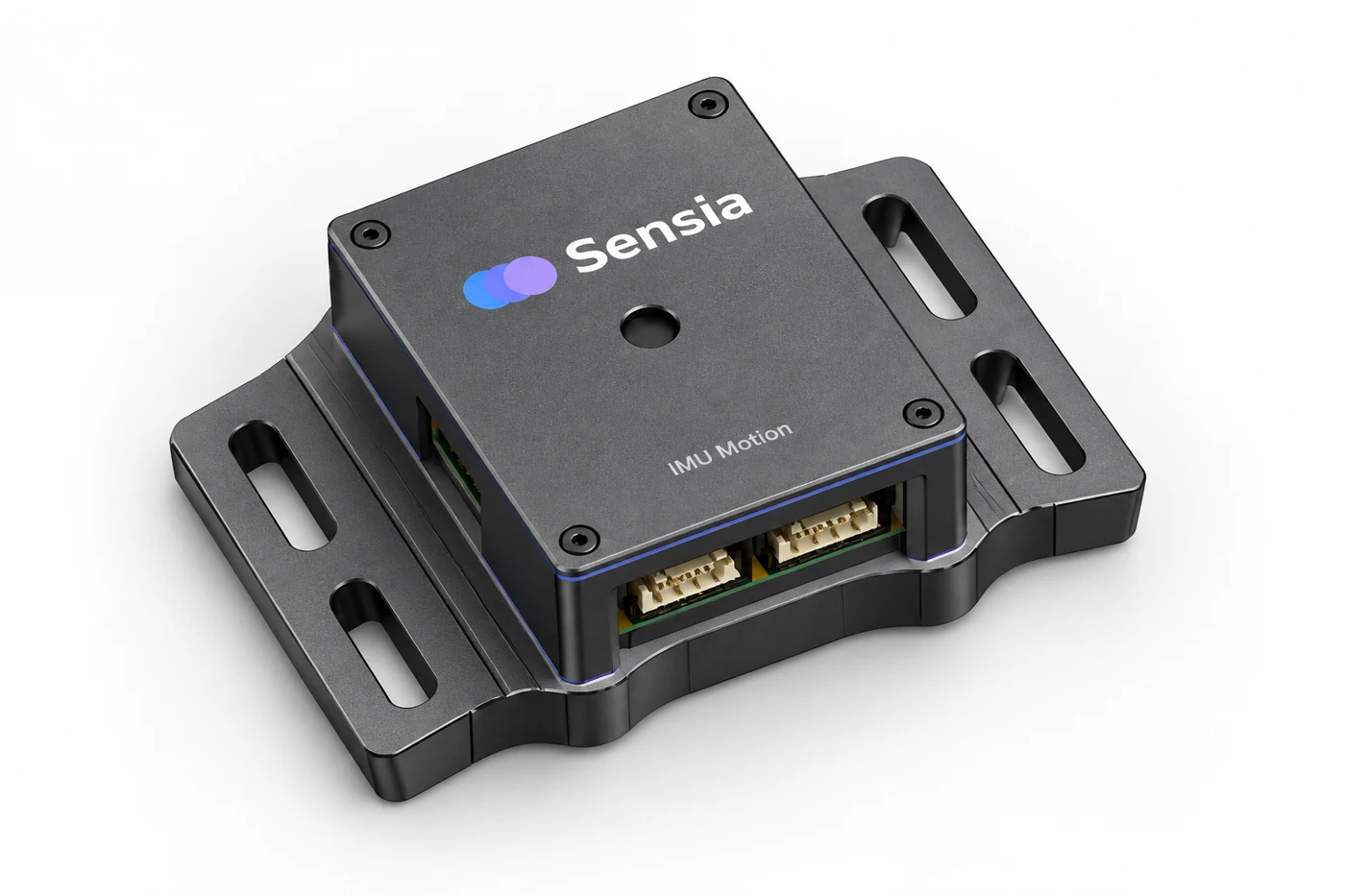
Record whole-body motion with distributed wearable inertial sensors, configured and positioned for the capture task.
Full-body motion capture
Collect motion data from inertial sensors worn at multiple body locations.
Distributed wearable nodes
Straps secure each sensor to the body. Node count and placement are configured for the capture task.
Part of a mobile capture setup
Combine with mobile equipment such as EdgePC to collect human motion and real-world task data.
Specifications
System and wear
- Product format
- Full-body inertial motion capture system
- Sensors
- Distributed inertial sensor nodes
- Mounting
- Straps at multiple body locations
- Capture and applications
- Full-body human motion; can be combined with other DataKit devices
- Configuration
- Full-body system, with node count and placement defined by the capture setup
- The product image shows one node, not the complete system. The full-body system is configured for the task; node count is not fixed.
Sensia DataKit EdgePC
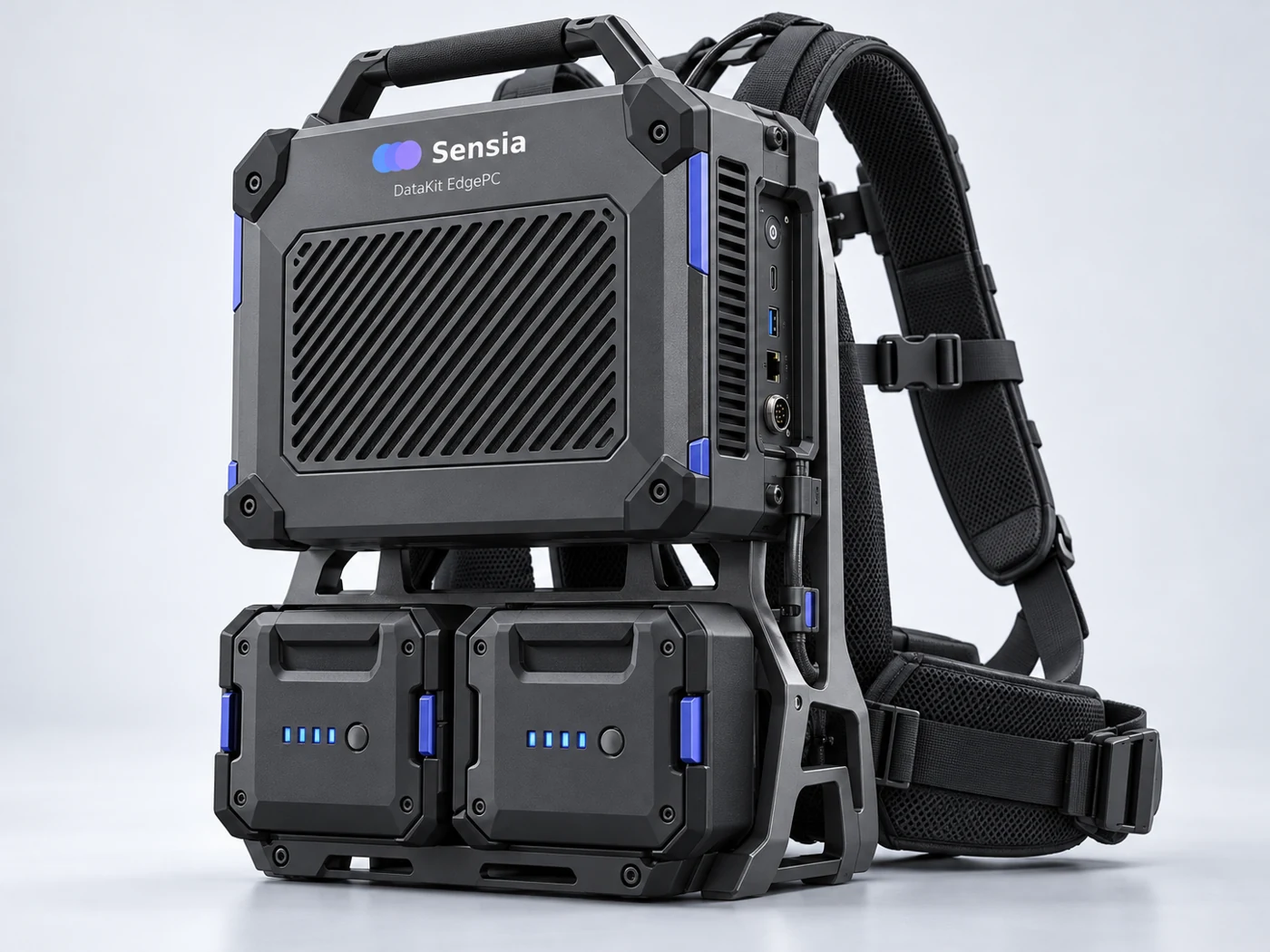
Carry capture computing into the task environment. EdgePC connects DataKit devices and runs data collection, processing and storage on the move.
Capture while moving
The backpack format follows the operator and reduces dependence on a fixed computer workstation.
Connect capture devices
Provide wearable computing for head-mounted, handheld, wrist-mounted or full-body capture setups.
Process and store at the edge
Run capture software and handle data collection, processing and storage alongside wearable capture devices.
Specifications
Device and operation
- Product format
- Backpack mobile edge computer
- Use
- Worn on the operator's back
- Device connectivity
- Connects Sensia DataKit capture devices
- Tasks
- Data collection, processing and storage
- Applications
- Data capture in mobile scenarios
Build your capture setup around the task.
Handheld demonstration kit
Combine two gripper views with a first-person view to capture manipulation and task context.
- Sensia DataKit UMI-Gripper × 2
- Sensia DataKit EGO × 1
Dual-wrist capture kit
Keep both hands free and connect close-up wrist views with a first-person view.
- Sensia DataKit UMI-Wrist × 2
- Sensia DataKit EGO × 1
Mobile handheld capture kit
Add EdgePC to the two-gripper and first-person setup for capture while moving through the task environment.
- Sensia DataKit UMI-Gripper × 2
- Sensia DataKit EGO × 1
- Sensia DataKit EdgePC × 1
Mobile dual-wrist capture kit
Combine both wrist views, a first-person view and wearable computing for natural task capture in real environments.
- Sensia DataKit UMI-Wrist × 2
- Sensia DataKit EGO × 1
- Sensia DataKit EdgePC × 1
Mobile full-body motion kit
Pair the full-body inertial capture system with EdgePC to record human motion during mobile tasks.
- Sensia DataKit IMU-Motion × 1
- Sensia DataKit EdgePC × 1
Discuss your configuration